

Policy Brief 12: De-risking of Russian clients: best intentions, unintended consequences
Abstract
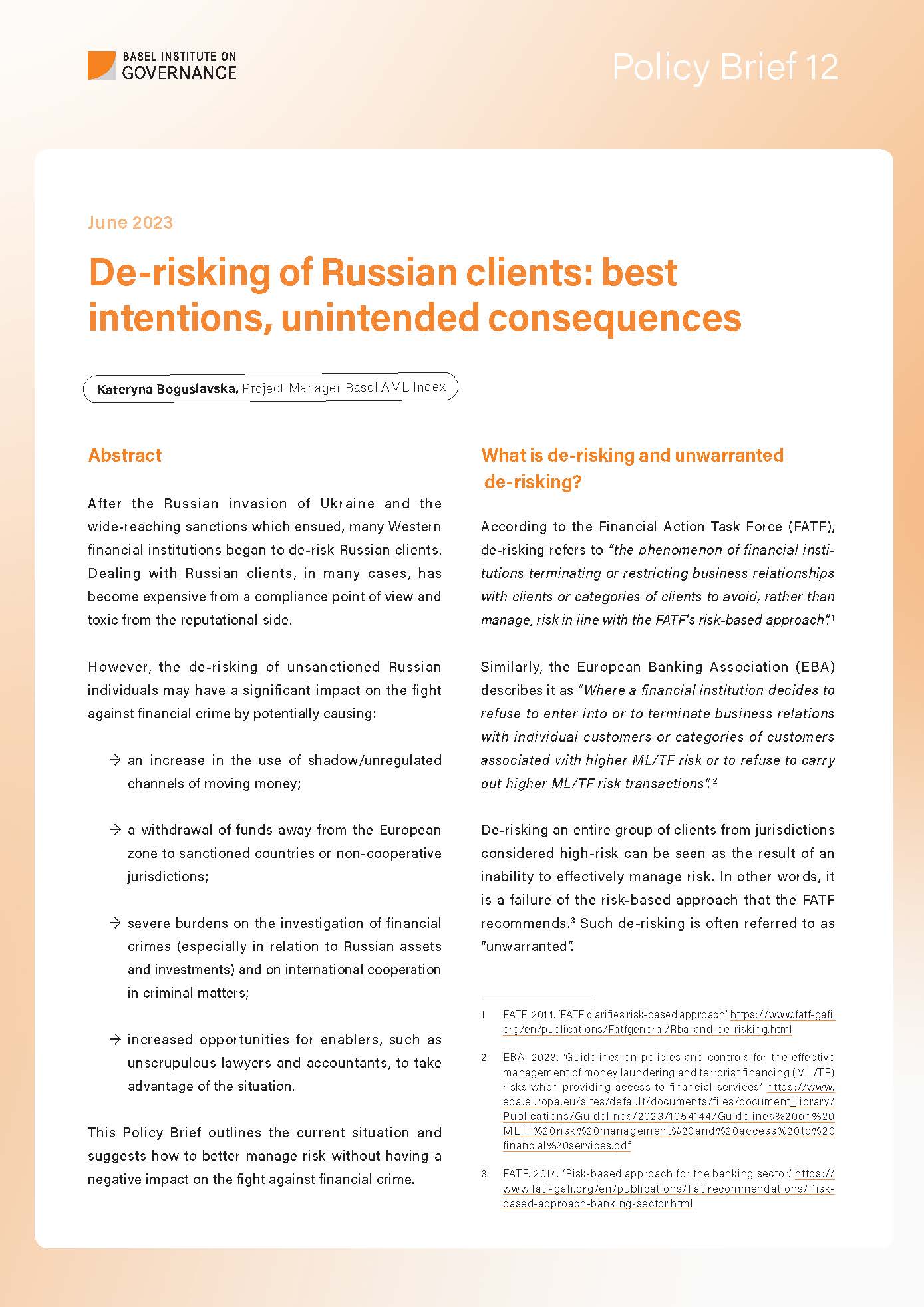
After the Russian invasion of Ukraine and the wide-reaching sanctions which ensued, many Western financial institutions began to de-risk Russian clients. Dealing with Russian clients, in many cases, has become expensive from a compliance point of view and toxic from the reputational side.
However, the de-risking of unsanctioned Russian individuals may have a significant impact on the fight against financial crime by potentially causing:
- an increase in the use of shadow/unregulated channels of moving money;
- a withdrawal of funds away from the European zone to sanctioned countries or non-cooperative jurisdictions;
- severe burdens on the investigation of financial crimes (especially in relation to Russian assets and investments) and on international cooperation in criminal matters;
- increased opportunities for enablers, such as unscrupulous lawyers and accountants, to take advantage of the situation.
This Policy Brief outlines the current situation and suggests how to better manage risk without having a negative impact on the fight against financial crime.
Literaturhinweise
Downloads
Veröffentlicht
2024-03-07
Zitationsvorschlag
„Policy Brief 12: De-risking of Russian clients: best intentions, unintended consequences“ (2024) Basel Institute on Governance Policy Briefs, (12), S. 5. doi:10.12685/bigpb.12.5.
Ausgabe
Rubrik
Artikel
Lizenz

Dieses Werk steht unter der Lizenz Creative Commons Namensnennung - Nicht-kommerziell - Keine Bearbeitungen 4.0 International.
Zitationsvorschlag
„Policy Brief 12: De-risking of Russian clients: best intentions, unintended consequences“ (2024) Basel Institute on Governance Policy Briefs, (12), S. 5. doi:10.12685/bigpb.12.5.