
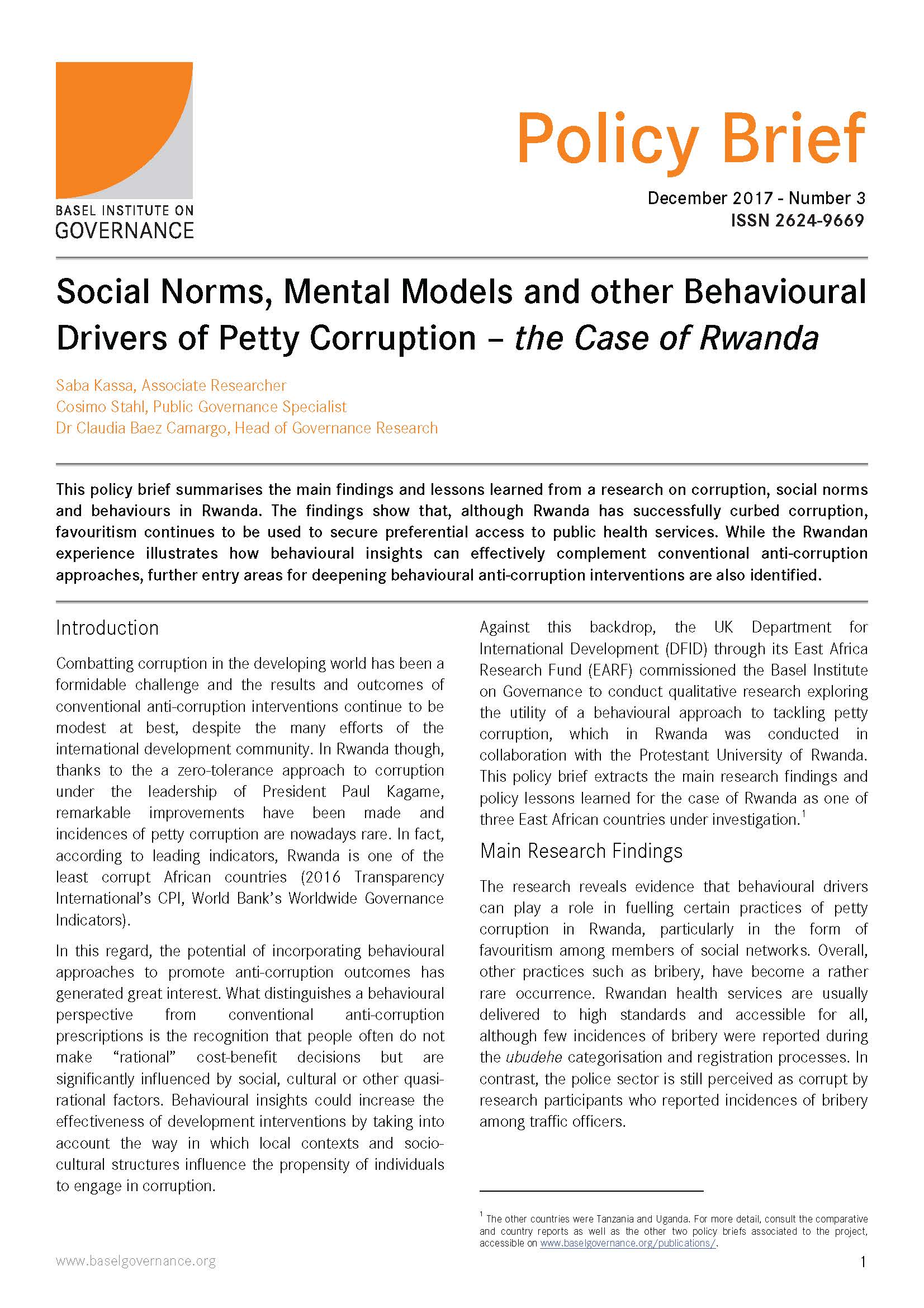
Policy Brief 3: Social norms, mental models and other behavioural drivers of petty corruption
The case of Rwanda
Schlagwörter:
Array, Array, Array, Array, Array, ArrayAbstract
This Policy Brief summarises the main findings and lessons learned from a research on corruption, social norms and behaviours in Rwanda. The findings show that, although Rwanda has successfully curbed corruption, favouritism continues to be used to secure preferential access to public health services.
While the Rwandan experience illustrates how behavioural insights can effectively complement conventional anti-corruption approaches, further entry areas for deepening behavioural anti-corruption interventions are also identified.
Literaturhinweise
Downloads
Veröffentlicht
2017-12-01
Zitationsvorschlag
„Policy Brief 3: Social norms, mental models and other behavioural drivers of petty corruption: The case of Rwanda“ (2017) Basel Institute on Governance Policy Briefs, (3), S. 1–4. doi:10.12685/bigpb.3.1-4.
Ausgabe
Rubrik
Artikel
Lizenz
Copyright (c) 2017 Basel Institute on Governance

Dieses Werk steht unter der Lizenz Creative Commons Namensnennung - Keine Bearbeitungen 4.0 International.
Zitationsvorschlag
„Policy Brief 3: Social norms, mental models and other behavioural drivers of petty corruption: The case of Rwanda“ (2017) Basel Institute on Governance Policy Briefs, (3), S. 1–4. doi:10.12685/bigpb.3.1-4.